
Unsupervised Machine Learning The Concept, Implications, Algorithms, and a Beginner’s Step-by-Step Project
Table of Contents
Introduction
Machine learning is changing the way we analyze and interpret data. Supervised machine learning models need labeled data, but real-world data are largely unlabeled. This is where Unsupervised Machine Learning for Non-Linearity plays a critical role.
Unsupervised machine learning tries to find patterns, structures, or relationships in data without any knowledge about outputs. It is a key component in exploratory data analysis, clustering detection/customer segmentation (and so on), but also in topic modeling and even dimensionality reduction.
In current data science practice, unsupervised learning serves as a preliminary step for supervised modeling in order to help analysts understand the behavior of data and assist with decision-making.
In this blog, we’ll give you a comprehensive run-through of what unsupervised machine learning is and how it works, including:
Definition and core concepts
- How unsupervised learning works
- Key algorithms
- Real-world implications and applications
- Simple beginner’s project with a detailed guide in Python
- Advantages and limitations
- Conclusion
- 10 detailed FAQs
What Is Unsupervised Machine Learning?
Unsupervised learning is where algorithms are trained to predict patterns, structures, or clusters from data that do not have specified target features.
Simple Definition
In other words, unsupervised machine learning searches for hidden patterns or intrinsic structures in the data while not being informed what the right output should be.
Technical Definition
Unsupervised machine learning is a class of learning technique where it can learn the structure from data that has not been labeled with tagged outputs, and one such technique is based on (a) similarity, (b) distance, or (c) statistical relationship.
- Key Characteristics of Unsupervised Learning
- Unsupervised learning is quite different from supervised:
- No labeled output variable
- Focuses on structure discovery
- Results tend to be exploratory rather than predictive
- Requires strong interpretation skills
- Commonly used for data understanding
The Importance of Unsupervised Machine Learning
In real-world scenarios:
Annotated data is costly and time-consuming to produce It is common for large datasets to have few obvious targets Decision makers want to make predictions before data is labeled
Unsupervised learning helps:
- Understand data distribution
- Detect hidden groups
- Identify anomalies
- Reduce data complexity
- Improve downstream supervised models
Types of Unsupervised Machine Learning
- The unsupervised learning methods can be broadly categorized into three groups.
Clustering
What Is Clustering?
Arranging groups of points close to each other in accordance with distance or similarity measures.
Objective
Every point in clusters should be very similar, and every point from different clusters should not be very identical.
Real-World Examples
- Customer segmentation
- Market basket analysis
- Social network analysis
- Image segmentation
- Common Clustering Algorithms
- K-Means
- Hierarchical Clustering
- DBSCAN
- Mean Shift
Dimensionality Reduction
What Is Dimensionality Reduction?
Dimensionality reduction to the least important features and maintaining important information.
Why It Matters
- Improves visualization
- Reduces noise
- Speeds up computation
- Prevents the curse of dimensionality
Common Algorithms
- Principal Component Analysis (PCA)
- t-SNE
- UMAP
- Autoencoders
Association Rule Learning
What It Does
Finds associations between variables in big data.
Example
“If a customer is buying bread and butter, they will not buy cheese.“ If a customer buys {bread,…
Common Algorithms
- A priori
- FP-Growth
How Unsupervised Machine Learning Works (with Step-by-Step guide)
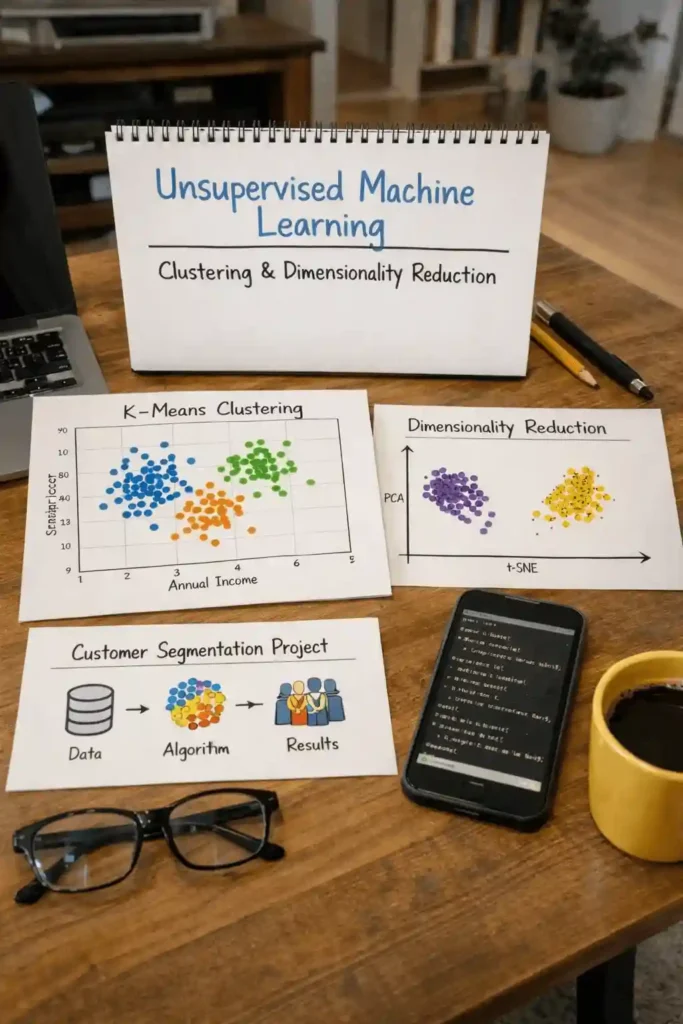
Beginners need to know the workflow Unsupervised Machine Learning
Step 1: Problem Understanding
- As their target variable does not exist, the objective function needed to be explicit:
- Do we want to group data?
- Reduce dimensions?
- Detct anomalies?
- Clear objectives guide algorithm selection.
Step 2: Data Collection
Data can come from:
- Transaction logs
- User behavior data
- Sensor data
- Web scraping: how to scrape website visit Web Scraping with Python in 7 steps
- Surveys
- No labeling is needed, unlike supervised learning.
Step 3: Data Exploration and Analysis (EDA)
EDA is of even greater significance in unsupervised learning. Visit for full blog on Exploratory data analysis.
Key EDA Tasks
- Distribution analysis
- Correlation analysis
- Outlier detection
- Feature scaling assessment
- EDA helps prevent misleading clusters.
Step 4: Data Preprocessing
Scale and noise are crucial for unsupervised algorithms.
Essential Preprocessing Steps
- Handling missing values
- Feature scaling (StandardScaler / MinMaxScaler)
- Removing irrelevant features
- Normalization
- Incorrect preprocessing may affect cluster creation: it may be distorted.
Step 5: Algorithm Selection
Choose algorithms based on:
- Data size
- Shape of clusters
- Noise level
- Interpretability needs
Example:
- K-Means → spherical clusters
- Views from the Front Lines (Cont.) DBSCAN → any shapes + noise
Step 6: Model Training
- The model identifies patterns by:
- Calculating distances
- Measuring similarities
- Optimizing internal criteria
- No score of accuracy in this phase is employed.
Step 7: Evaluation and Interpretation
Subjective Criteria and their Interrelations The evaluation is subjective and depends on:
- Silhouette Score
- Elbow Method
- Domain knowledge
- Visualization
Practical Application of Unsupervised Machine Learning
Unsupervised learning has implications for many different businesses.
- Business and Marketing
- Customer segmentation
- Personalized marketing
- Product recommendations
- Finance
- Fraud detection
- Risk profiling
- Transaction anomaly detection
- Healthcare
- Disease subtype discovery
- Patient similarity analysis
- Medical image clustering
- Economics and Policy
- Poverty clustering
- Inflation regime detection
- Regional development analysis
- Cybersecurity
- Network intrusion detection
- Suspicious behavior analysis
Customer Segmentation Using K-Means Clustering
This project is ideal for beginners and demonstrates unsupervised learning clearly.
Project Objective
To segment customers based on annual income and spending score using K-means clustering.
Step 1: Import Required Libraries
import pandas as pd

import matplotlib.pyplot as plt

from sklearn.cluster import KMeans

from sklearn.preprocessing import StandardScalerExplanation
- pandas → data handling ( 5 Uses of Pandas in Data analysis: Beginners Should Know is AVAILABLE FOR MORE INDEPTH Knowledge)
- matplotlib → visualization
- KMeans → clustering algorithm
- StandardScaler → feature scaling
Step 2: Create Sample Dataset
data = {
    'Annual_Income': [15, 16, 17, 18, 19, 60, 62, 65, 70, 72],
    'Spending_Score': [39, 81, 6, 77, 40, 50, 60, 65, 80, 85]
}
df = pd.DataFrame(data)data = {Explanation
This dataset mimics customer income and spending behavior.
Step 3: Data Preprocessing
scaler = StandardScaler()
scaled_data = scaler.fit_transform(df)Why Scaling Is Important
K-means relies on distance calculations. Without scaling, variables with larger values dominate clustering.
Step 4: Choosing Numbers of Clusters (Elbow Method)
inertia = []
for i in range(1, 6):
    kmeans = KMeans(n_clusters=i, random_state=42)
    kmeans.fit(scaled_data)
inertia.append(kmeans.inertia_)Explanation
The elbow method helps determine the optimal number of clusters by minimizing within-cluster variance.
Step 5: Train K-Means Model
kmeans = KMeans(n_clusters=3, random_state=42)
clusters = kmeans.fit_predict(scaled_data)
df['Cluster'] = clustersExplanation
The model assigns each customer to a cluster based on similarity.
Step 6: Visualize Clusters
plt.scatter(df['Annual_Income'], df['Spending_Score'], c=df['Cluster'])
plt.xlabel('Annual Income')
plt.ylabel('Spending Score')
plt.title('Customer Segmentation')
plt.show()Interpretation
Each color corresponds to a particular segment of customers.
Learning Outcomes from the Project
- Understanding unsupervised workflow
- Importance of scaling
- Cluster interpretation
- Real-world business application
Advantages of Unsupervised Machine Learning
- No labeling required
- Ideal for exploratory analysis
- Discovers hidden patterns
- Scales well with large datasets
Limitations of Unsupervised Machine Learning
- No ground truth for evaluation
- Interpretation can be subjective
- Sensitive to preprocessing
- Results may vary by algorithm
Conclusion
Unsupervised machine learning is an integral part of the modern data science discipline, particularly in scenarios where labeled data may be scarce or expensive. Through revealing hidden structure in data, clustering reduces the complexity of data and makes data more understandable; it is particularly useful when labeled material is not available.
Whether in customer segmentation or fraud detection, healthcare analysis or econometric research, unsupervised learning gives us the ability to model and understand without ever needing an answer key. Learning unsupervised techniques like clustering and dimensionality reduction is a must for beginners who want to get the essentials of inbuilt analytical intuition upfront.As data gets larger and more unmanageable, unsupervised machine learning will be at the heart of exploratory and smart data analysis.
for more indepth knowledge to boost your skills you should read Unsupervised Machine Learning — A Complete Overview on medium
Also read blog How to Utilize Unsupervised Machine Learning to Automatically Detect Patterns in Text on TDS
Frequently Asked Questions
1.What is unsupervised machine learning?
It is a type of learning that can find patterns in unlabeled data.
2.What is special about unsupervised learning as compared to supervised learning?
The difference is that unsupervised learning has no target variable, whereas supervised learning does.
3.What are common unsupervised algorithms?
K-Means, Hierarchical Clustering, DBSCAN, PCA, and Apriori.
4.Is unsupervised learning accurate?
The notion of accuracy is relative and knowledge-based.
5.Is it possible to apply the unsupervised learning for the big data?
Yes, a lot in big data analytics.
6.Why is cluster scaling important?
Because the size of the features matters in distance-based algorithms.
7.Is unsupervised learning applied to economics?
Yes, for regime discovery, finding clusters of locations and policy study.
8.Can unsupervised learning detect fraud?
Yes, through anomaly detection techniques.
9.Is unsupervised learning good for noobs?
Yes, particularly for data behavior type of things.
10.Is it okay to apply unsupervised learning prior to supervised learning?
Yes, in most case to investigate data and create better features