Table of Contents
Introduction
How to use lambda functions in Python programming? Lambda functions are the anonymous (unnamed) functions that are defined using the keyword lambda. They are often used for one-off, short operations where a full function is not needed. They have multiple arguments but only a single expression, which is automatically returned. Often used with higher-order functions such as map, filter, and reduce for list transformations and aggregations. ly used for quick, one-time operations where defining a full function would be unnecessary. These functions can have multiple arguments but contain only a single expression, which is automatically returned.
Key Characteristics:
- Syntax: lambda arguments: expression
- Compact and concise.
Often used with higher-order functions like map, filter, and reduce for list transformations and aggregations.
Examples of Lambda Functions:
- Mathematical Operations:
Solving problems with algebraic expressions, squaring, and cubing.
- Data Transformation:
3. Modifying lists with map.
4. Data Filtering: Using a filter to select elements from lists.
5. Aggregation: Using reduce to sum or multiply list elements
Basic Lambda Function:
x = lambda a: a * a 
Concept: This lambda function accepts a single argument ‘a’ and returns its square.
- Lambdas are anonymous functions (no need for the def keyword or a function name) often used for simple, quick operations.
Use Case: Used for single expression operation that does not need a formal function definition, like squaring or mathematic evaluation. Like above, but the cube of z is calculated. Defined using the lambda keyword. They are typically used for quick, one-time operations where defining a full function would be unnecessary. These functions can have multiple arguments but contain only a single expression, which is automatically returned.
2. Lambda for Cubing a Number:
y = lambda z: z * z * z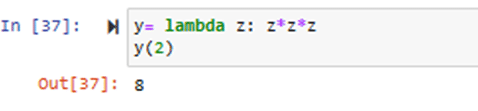
Concept:
- Like the above but calculates the cube of the input z.
- Purpose: Used when you want to do a repetitive operation (e.g., computing powers) without writing a named function
3. Lambda with filter:
my_list = [1, 2, 3, 4, 5, 6, 7, 8]
newl = list(filter(lambda a: (a / 4 == 2), my_list))
Concept:
- The filter function applies the lambda to each element in the list.
- The lambda evaluates if the division of the element by 4 equals 2, returning only those elements that satisfy the condition.
Use Case: Getting values from a collection, based on a logical condition. Example: Valid input selection from user data or datasets. Applying lambda to every element in the list is done by the map function.
Every element is checked if it doesn’t fulfill the condition a / 4 == 2, which returns a list of Boolean values (True or False). e.g., operations where defining a full function would be unnecessary.
4. Lambda with map:
newlist = list(map(lambda a: (a / 4 != 2), my_list))
Concept:
The map function applies the lambda to every element in the list. Each element is checked for whether it does not satisfy the condition a / 4 == 2, resulting in a list of Boolean values (True or False).
Use Case: These transformations can include the process of converting a numerical value or applying conditions to all elements in a collection. reduce comes in handy to apply a lambda function cumulatively across list elements and reduce it down to a single value. This lambda hits upon two numbers one after the other.
5. Lambda with reduce:
From functools import reduce
reduce(lambda a, b: a + b, [23, 56, 43, 98, 1, 45])Concept:
- Reduce is used to apply a lambda function cumulatively across elements in the list, reducing it to a single value.
- This lambda adds two numbers at a time, moving sequentially through the list.
- Use Case:
Aggregating a collection into a single result, like finding sums, products, or concatenating strings.
6. Lambda for Algebraic Equations:
d = lambda x, y: 3 * x + 4 * yRepresents a linear equation 3x+4y.
Quadratic:
v = lambda a, b: (a + b) ** 2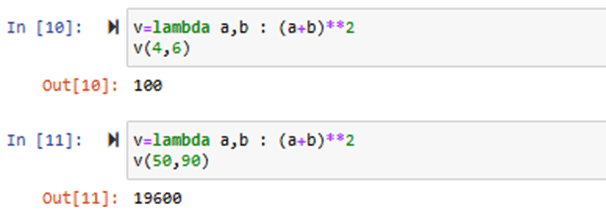
Represents (a+b)2(a + b)^2(a+b)2, compactly solving algebraic problems.
Use Case (Both): It simplifies mathematical and logical code computations for concise expressions. Elements where a / 2 == 2 are filtered out in the list. Filters keep only values for which the lambda returns True. The lambda keyword. They are typically used for quick, one-time operations where defining a full function would be unnecessary. These functions can have multiple arguments but contain only a single expression, which is automatically returned.
7. Lambda with Filtering Elements:
myList = [1, 2, 3, 4, 5, 6, 7]
newlist = list(filter(lambda a: (a / 2 == 2), myList))
Concept:
- Filters elements satisfying a / 2 == 2 in the list. • Filters work by retaining only values for which the lambda returns True.
Use Case: Where we remove irrelevant or unwanted items from a dataset
Adds 3 to every element of the list by using map. d) functions defined using the lambda keyword.
8. Lambda in Transformation:
y=tuple(map(lambda x: x+3,lst))print(y)
OUTPUT: (4, 5, 6, 7, 8, 9)
Concept:
- Uses map to add 3 to every element of the list.
Purpose: Transforming or processing data collection without having to manually iterate over it.
9. Lambda with Multiple Higher-Order Functions:
r = reduce(lambda x, y: x + y, map(lambda x: x: x: x + x, filter(lambda x: (x <= 4), [1, 2, 3, 4, 5, 6, 7, 8])))
Concept:
- Combines filter, map, and reduce:
- filter picks elements satisfying x≤4x \leq 4x≤4: [1, 2, 3, 4] [2, 3, 4] [3, 4][4][1, 2, 3, 4].
- map doubles each element: [2, 4, 6, 8] [2, 4, 6, 8] [2, 4, 6, 8].
- These values are reduced to sums and returned in 2020.
Use Case: Processes and aggregates data in one operation, efficiently.
General Takeaways:
Basics: Lambdas are used for quick, inline operations and are great for anonymous or temporary use.
Filter: Filters out values based on a condition, retaining only the relevant data required.
Map: Returns a new element, which is a result of applying a function to every item of the collection. Reduce: This is basically a function that aggregates collections into a single result by sequentially applying a function. Such are the lambda concepts, and you cannot do away with them if you want to be involved in functional programming in Python. They are very useful when you want to streamline operations on lists, tuples, and other iterables.
External source to learn about lambda functions in mathematical operations.
W3 School: Python Lambda
How to Use Python Lambda Functions